
Partial Fractions
Further Mathematics S.S.S 3 First Term
WEEK 1
Partial Fractions
Performance Objectives
Students should be able to:
- The basic definition
- To resolve rational functions into partial fractions
Content
The process of transforming a compound algebraic fraction into a sum of partial fractions is called ‘resolution into partial fractions’.
Partial and Compound Fractions
The method of combining two or more simple algebraic fractions to obtain a single algebraic fraction is quite familiar.
For example,

The fractions  and
and  cannot be made simpler than the form in which they are now. They are said to be the partial fractions of the fraction
  . The fraction
  on the other hand is said to be the compound fraction of
  and
and  .
.
Splitting a Fraction
Suppose we start with a compound algebraic fraction, how do we perform the reverse process of expressing it as a sum of partial fractions? The process of transforming a compound algebraic fraction into a sum of partial fractions is called resolution into partial fractions.
By conversion, our partial fractions must be proper in the sense that the degree of the numerator must be less than the degree of the denominator.
Also, they must be in their simplest forms in the sense that they must not split into other fractions. The partial fractions for any compound fraction will be determined strictly by the nature of the factors at the denominator.
Let us start from the fraction  and attempt to obtain the partial fractions.
By conversion, the degree of numerator must be less than the degree of the denominator for any partial fraction. Also, the partial fraction is determined by the nature of the factors at the denominator of the compound fraction.
Hence writin 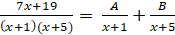 is quite an in order.
Combining the fractions at the right-hand side

The fractions at the left-hand side and the right-hand side are equivalent. Since they have identical denominators, their numerators must be identical.
Henc  is an identity and must be equal for all values of x. Note the difference between an identity and an equation. An identity is true for all values of x, while an equation is true for some particular values of x.
Coming over to the identity:

To find  :
:
Put  = -5
= -5
 = 16
= 16

 = 4
= 4
To find  :
:
Put  = -1
= -1
 = 12
= 12

 = 3
= 3
Hence 
Types of Partial Fractions
Partial fractions are characterized by the nature of factors at the denominator of the compound fraction we are required to resolve.
As a general rule, if a factor in the denominator is a polynomial of degree  then the numerator of the corresponding partial fraction will be a most general polynomial of degree
  . Partial fractions fall generally into four categories:
- Those with non-repeated linear factors at the denominator.
- Those with non-linear factors that are not repeated.
- Those with repeated factors linear or nonlinear.
- Improper fractions.
Non-repeated Linear Factors at the Denominator
These are generally of the form

Where Q(x) is a polynomial whose degree is less than the degree of the product of the polynomials in the denominator.
For each factor  , assign the partial fraction
Hence,
)

Example 1
Resolve  into partial fractions.
Solution


To find  ,
,
Put  = -4
= -4
 = -5
= -5

 =
= 
To find  ,
,
Put x = -1
 = 1
= 1

 =
= 
Hence,
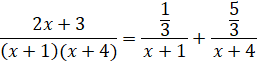
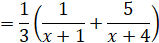
Example 2
Use the method of comparing coefficients to resolve  into partial fractions.
Solution



Equating coefficients of x :
 ..... (1)
Equating constant terms
 ..... (2)
Solving equations (1) and (2) simultaneously
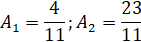
Hence

Example 3
Use the cover-up method to resolve 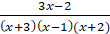 into a partial fraction.
Solution

To find A1 write the fraction as

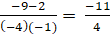
Put  = -3
= -3

 =
= 
To find A2 write the fraction as

Put  = 1
= 1

 =
= 
To find A3 write the fraction as

Put x = -2

 =
= 
Hence:

Other Non-repeated Factors at the Denominators
The denominator of the compound fraction we about to resolve into partial fractions may have other factors which are quadratic, cubic or even any polynomial of higher degrees.
If a quadratic factor which is not factorizable occurs in the denominator, assign to the numerator of the corresponding partial fraction, the most general linear factor. If it is a cubic factor that is not factorizable that occurs in the denominator, assign to the numerator of the corresponding partial fraction, the most general quadratic factor.
In general, if a non-factorizable polynomial of degree n occurs at the denominator of the compound fraction, assign the most general polynomial of the degree n-1
 to the numerator of the corresponding part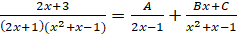

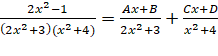

The method of comparing coefficients can be used to determine the constants.
Example 4
Resolve  into partial fractions.
Solution




Put x = -1

 =
=
 A =
A = 

Equating coefficients of  :
:


 =
= 
Equating coefficients of x :
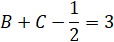


 =
= 

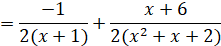
Hence:

Example 5
Resolve 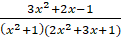 into partial fractions.
Solution



Rearranging,

Equating the coefficients of
 .....(1)
Equating the coefficients of 
 .....(2)
Equating the coefficients of x
 .....(3)
Equating the constant terms:
 .....(4)
Solving the four equations simultaneously
 = 1;
= 1;  = 1;
= 1;  = -2;
= -2;  = -2
= -2
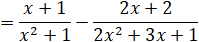
Hence:

Repeated Factors at the Denominators
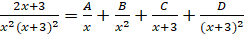
If the denominator has a repeated linear factor of the form, assign partial fractions of the form:

For example:

Example 6
Resolve  into partial fractions.
Solution



Putting x = 3
= 3
 =
= 

 =
= 
Putting x = -1
= -1
 =
= 
∴ =
= 


Putting x = 0
= 0
 =
= 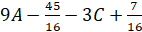
∴  =
=  ...(1)
Putting x = 1
= 1
 =
= 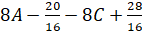

 = 1
= 1 ...(2)
Solving (1) and (2) simultaneously
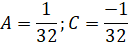
Hence:

This method of finding the constants is called the method of direct substitution.
Improper Fractions
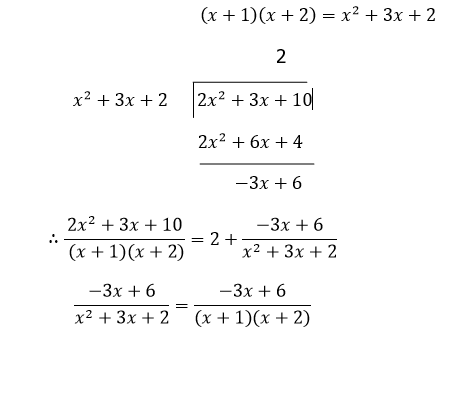
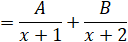
Sometimes the degree of the numerator of the fraction we wish to resolve into partial fractions may be equal or higher than the degree of the denominator. In this case, we first use long division to divide the numerator by the denominator before we proceed to resolve into partial fractions.
Example 7
Resolve  into partial fractions.
Solution
Expanding the denominator



Put  = -2
= -2
 =
= 
 =
= 
Put x = -1
 =
= 

Hence:
