
Position, Distance and acceleration
Physics SSS2 First Term
Sub Theme: Interaction of matter, space and time
WEEK 1
Position, Distance and acceleration
Performance Objectives
Students should be able to;
- Use a Cartesian system to locate the position of an object on the x-y plane.
- Define distance, position and displacement
Position
Content
The position is the location of a point/object with respect to a reference point. The position of a point in space is defined in terms of the distance of the point from the reference point (which is sometimes called ORIGIN). In physics, the position of an object in space is represented in a coordinate system. There are three main types of coordinate system for representing the position of an object in space:
- Cartesian coordinate system
- Spherical coordinate system
- Cylindrical-coordinate system
Of all these, the Cartesian coordinate system is the most commonly used.
The Cartesian Coordinate System
This is also called the rectangular coordinate system. This consists of two (or three) mutually perpendicular axes. The Cartesian plane in two dimensions consists of two mutually perpendicular axes:
- the horizontal axis (also called the X-axis or the abscissa)
- the vertical axis (also called the Y-axis or the ordinate).
The position of a point in this coordinate system is defined in terms of its perpendicular distance from these axes. (0,0) is the origin.
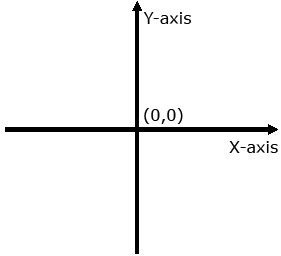
For instance, the position of a point P defined as (a,b) is represented as shown below.
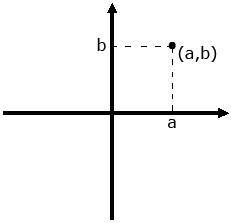
This is similar to the location of a point on a graph sheet when plotting points.
Distance
This can be defined as the actual length measured along the path moved by an object. Distance is a scalar quantity and it S.I unit is the metre (m). If an object moving along a straight line, the distance moved is the length of the straight line. If the path is a curve, then the distance moved is the length of the curve.
Displacement
This is the distance moved in a specified direction. Displacement is a vector quantity and its S.I unit is metre.
Estimation of Displacement between Two Points on the Cartesian Plane
Consider the point P and Q on a Cartesian plane. If the coordinate of P and Q is given as: P(x1,y1) and Q(x2,y2), then the displacement between P and Q on the Cartesian plane is given as
D = 
Example
Calculate the distance between the two points: P(4,2) and Q(1, 6)
Solution
P(x1,y1) | Q(x2–y2)
P(4,2) | Q(1,6)
x1 = 4, y1 = 2 | x2 = 1, y2 = 6
D = 
D =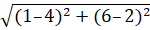
D = 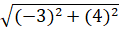
D = 
= 
= 5 units
Displacement between Two Points on the Cartesian Plane
Consider the points P and Q on a Cartesian plane. If their coordinates are: P(x1,y1,z1), Q(x2,y2, ), then the distance between P and Q on the Cartesian plane is given as
D =
E.g: Calculate the distance between the points P(2, 0, 5) and Q(3, -2, 1)
Solution
P(2, 0, 5) = (x1, y1, z1)
Q(3, -2, 1) = (x2, y2, z2)
D = 
D = 
D = 4.58units
Differences between Distance and Displacement
|
S/N |
Distance |
Displacement |
|
|
1 |
It is the actual length of the |
It is the distance moved |
|
|
2 |
It is a scalar quantity. |
It is a vector quantity. |
|
Frame of Reference
This is a set of axes used to specify the position of the object in space at any instant of time. For practical purposes, the frame of reference of the earth is taken to be at rest (i.e an inertia frame of reference). However, this is never so. In two dimensional continuums, the frame of reference consists of two axes.
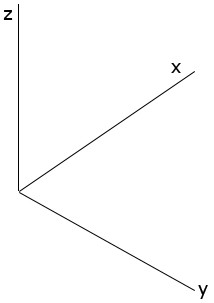
The above is a three-dimensional frame of reference to specify the position of an object at any time in space.
In four-dimensional continuums, the time coordinate is added to the space coordinate (x, y, z). Hence for three-dimensional frames of reference position is defined as (x,y,z). But for a four-dimensional frame of reference, the position is define as (x,y,z,t) – (space-time)
When an event in a frame of reference is observed in two frames of reference moving relatively with respect to each other, their observations will be different. This leads to the concept of relativity. (see Einstein theory of special relativity)
However, all frames of reference moving at a constant velocity with respect to each other are equivalent. All frames of reference at rest or moving with uniform velocity are called Galilean frames and that are equivalent for describing the dynamics of moving bodies.