
Speed, Velocity and acceleration
Physics SSS2 First Term
Sub Theme: Interaction of matter, space and time
WEEK 3
Speed, Velocity and acceleration
Performance Objectives
Students should be able to;
- Define speed, velocity and acceleration
- Show that speed is a scalar quantity while velocity and acceleration are vectors
- Show on a (V – t) graph the motion of a body
- Deduce the distance covered between any time intervals on the graph in 3 above
Velocity – Time v-t Graph
Content
1. Gradient of a v-t graph = acceleration
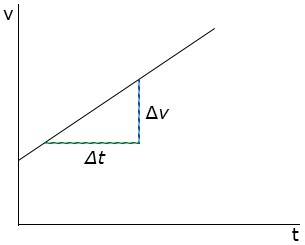
Acceleration = gradient = change in velocitychange in time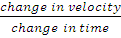
acceleration(a) = 
2. Area under a v - t graph = distance.
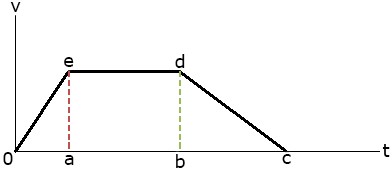
- Total distance covered during the motion = area of trapezium 0edc
- Distance covered during acceleration = area of triangle 0ea
- Distance covered during constant velocity = area of rectangle aedb
- Distance covered during deceleration = area of triangle bdc
- Acceleration = slope of line 0e, a =

- Deceleration = slope of dc, −a =

Example 1:
A car starts from rest and accelerates uniformly to 15ms-1 in 5 s. It then continues at this velocity for the next 10s before decelerating back to rest in another 8 s.
Use the information to answer the following questions
- Sketch the velocity time graph of the motion of the car
- Calculate the acceleration of the car
- Calculate the deceleration of the car
- What is the total distance travelled by the car
- Estimate the average speed of the car.
Solution:
1.
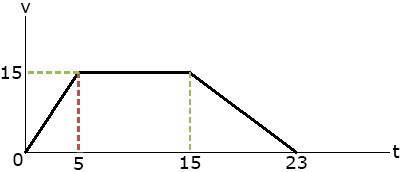
2. Acceleration a = 
a = 15/5 =3ms−2
3. Deceleration –a = 
−a =  =
= 
-a = −1.875ms−2
4. Total distance = area under the graph = area of trapezium
S = (a + b)h
S =  (15 − 5) + (23 − 0)15
S =  (10 + 23)15
S =  =
= 
S = 247.5m
5. Average speed v = total distancetotal time
V = 
= 10ms−1
Example 2:
A body at rest is given an initial uniform acceleration of 8.0ms2 for 30s after which the acceleration is reduced to 5.0ms2 for 30s. The body maintains the speed attained for 60s after which it is brought to rest in 20s.
(a) Draw the velocity-time graph of the motion using the information given above.
Using the graph, calculate
(b) Maximum speed attained during the motion.
(c) Average retardation as the body is brought to rest.
(d) Total distance travelled during the first 60s
(e) Average speed during the same intervals as in (c)
Solution
(a)
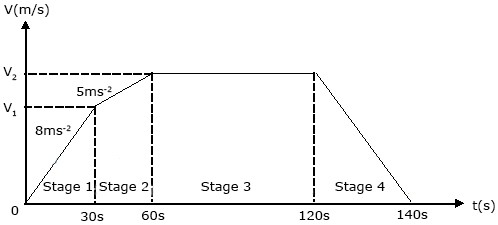
(b) There are two stages of acceleration
Stage 1: Acceleration = gradient
a = 8ms−2
a = 
8 = 
Cross multiplying,
V1 = 8 × 30 = 240ms−1
Stage 2: a = 5ms−2
a = 
5 = 
Cross multiplying,
V2 − V1 = 150
But V1 = 240
V2 – 240 =150
V2 = 150 + 240 = 390ms−1
The maximum velocity is 390ms−1
(c) Average retardation is equal to gradient
−a = 
But V2 = 390ms−1
−a = 
−a = 19.5ms−2
Average retardation =−19.5ms−2
(d) Distance is in the first 60sec = area of triangle + area of the next trapezium
S =  (time) V1 +
  (V1+V2) times
=  (30)(240) +
  (240 + 390)30
S = 3600 + 9450
= 13050m
(e) Average speed V = 
V = 
= 217.5ms−1
Relative Motion
This is the motion of a body with respect to another. All motion is relative. The motion of a car on the road is with respect to the earth or any other frame of reference in which the motion of the car is being observed.
Resultant Velocity of Relative Motions
- Consider two cars X and Y travelling in the same direction and at the same speed, a commuter in X will observe that Y is stationary (not moving)
Vx = Vy
Relative velocity Vx − Vy = 0
- If car X is to be travelling at a speed Vx which is greater than the speed of Vy, a commuter in car Y will observe the speed of car X to be
Vx − Vy = relative velocity of car X with respect to Y
A commuter in X will observed the relative velocity of Y to be
Vy − Vx
This value will be negative. This means that to an observer in X, the car Y will appear to be going backward (going the opposite direction with a speed of /Vy − Vx/
- But if car X and Y were to be travelling in opposite direction, the relative velocity of X with respect to Y will be
Vx − Vy = relative velocity of X with respect to Y
Vy − Vx = relative velocity of Y with respect to X
N.B. note that the relative velocity of X with respect to Y, Vxy is equal in magnitude but opposite in direction to the relative velocity of Y with respect to X, Vyx.
Vxy = −Vyx
Examples
1. Two racing cars A and B travelling in the same direction at 300m/s and 340mls respectively. What is the relative velocity of A with respect to B?
Solution:
Va = 300km/h
Vb = 340km/h
Relative velocity of a with respect to B, Vab = Va − Vb = 300 – 340
= −40km/h
(Note that this is negative. A appears to be travelling in the opposite direction to B)
2. A boat whose speed is 8 km/h sets course on a bearing 0600. If the tide is running at a speed of 3 km/h from a bearing of 3300, find;
3. The actual speed of the boat(i.e, relative speed of the boat)
The direction of travel
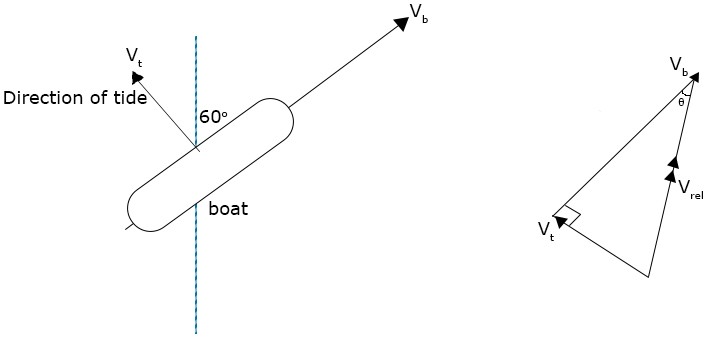
To obtain the relative velocity (actual velocity), draw the component velocity such that the head of one point to the end of the other. Draw the relative velocity to beginning from end of the first to the head of the last.
Using Pythagoras theorem
 = 82 + 32
 = 64 + 9 = 73
 = 73
= 73
= 8.54kmh−1
Let ϴ be the angle between the relative velocity and the direction of the boat.
tanθ =  =
= 
θ = tan−1[0.375] = 20.6o